
S c h o l a r s h i p
My Research: Mid-Twentieth Century
Irish Theatre and Drama
As a theatre historian and performance theorist, my research focuses on Irish theatre and drama, especially in the mid-twentieth century, but pursues multiple lines of inquiry. Much of my work to date has investigated transnational issues in Irish theatre. This has included, for example, a series of histories of banned Irish plays performed both within and beyond Ireland as well as transnational dimensions of Irish playwright Samuel Beckett’s dramas. I am also working, however, to illuminate and elaborate or key social and political issues in mid-century Irish theatre — a much-neglected period in Irish theatre historiography. While 1950s and ‘60s Ireland were marked by deeply repressive, parochial, and isolated, the theatre and drama of the time tells a more complicated story. My work thus explores two related dynamics: how the circulation of people, media, capital, and ideas influenced the development of Irish drama and theatre; and how Irish dramatic performance participated in and intervened into social debates about politics, religion, sexuality, gender, nationalism, and class on the island of Ireland and around the world.
Moving Censorship: Theorizing Censorship through Transnationalism
In 1958, the Archbishop of Dublin protested the inclusion of two plays in the proposed program for that year’s Dublin International Theatre Festival: Seán O’Casey’s The Drums of Father Ned and Allan McClelland’s Bloomsday, an adaptation of James Joyce’s novel Ulysses. The Archbishop’s refusal to permit a mass to open the annual spring cultural festival (which the theatre festival was a part of) so long as O’Casey and Joyce remained on the program. The result was the cancellation of the entire theatre festival.
Two of my scholarly publications follow these plays to their eventual productions to explore how their censorship informed their performance and reception.
“Remembering Censorship in the World Premiere of Seán O’Casey’s The Drums of Father Ned: Lafayette, Indiana, 1959.”
Journal of American Theatre and Drama 37.2 (2025).
This article reconstructs the world premiere of The Drums of Father Ned by an amateur community theatre in Lafayette, Indiana in 1959. The producing Lafayette Little Theatre took every advantage to drum up support for the production among local Hoosiers. Since they did not have any knowledge of the play’s banning, they built a memory of the play’s censorship for the community through publicity, the production program, and other production-adjacent materials. They further touted the production as a particularly American endeavor, painting Ireland as a wholly repressive, negative space. Only in the “Land of the Free” could O’Casey’s play be given voice. This framework, though, was very likely undermined by the context of Cold War Indiana and Lafayette, specifically. O’Casey’s play is rather pro-communist in its messaging and themes, and Lafayette beat the drum of anti-communist fervor during the then-ongoing Red Scare. Drawing on previously unpublished archival sources, this article ultimately argues that the transnational frame of Irish censorship that the production used to both sell the production and help local Hoosiers understand the performance came into stark tension with the politics of Lafayette.

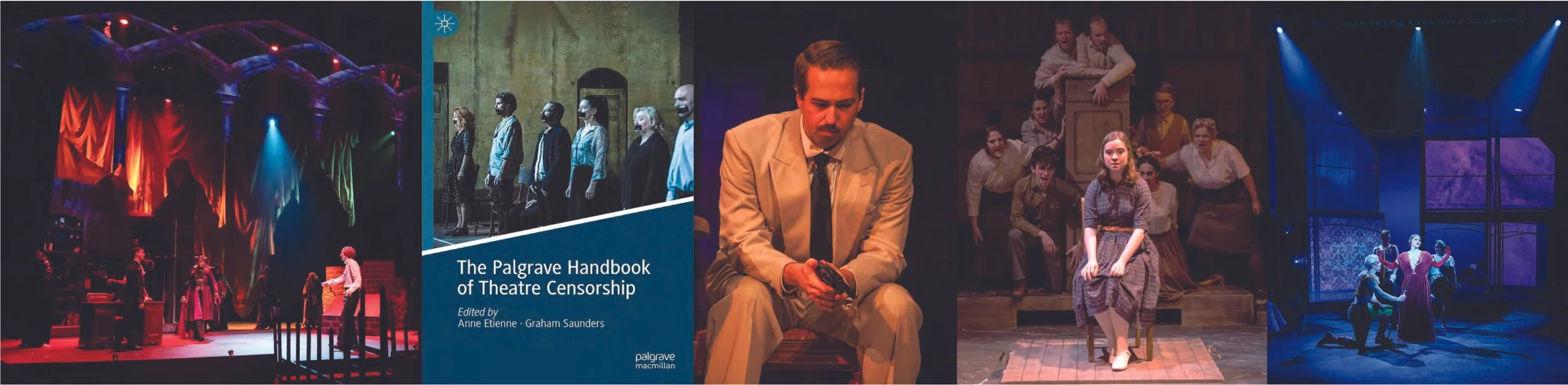
A scene from the world premiere performance of Seán O'Casey’s The Drums of Father Ned by the Lafayette Little Theatre in Indiana, 1959. Courtesy of Shivaun O’Casey and the National Library of Ireland.
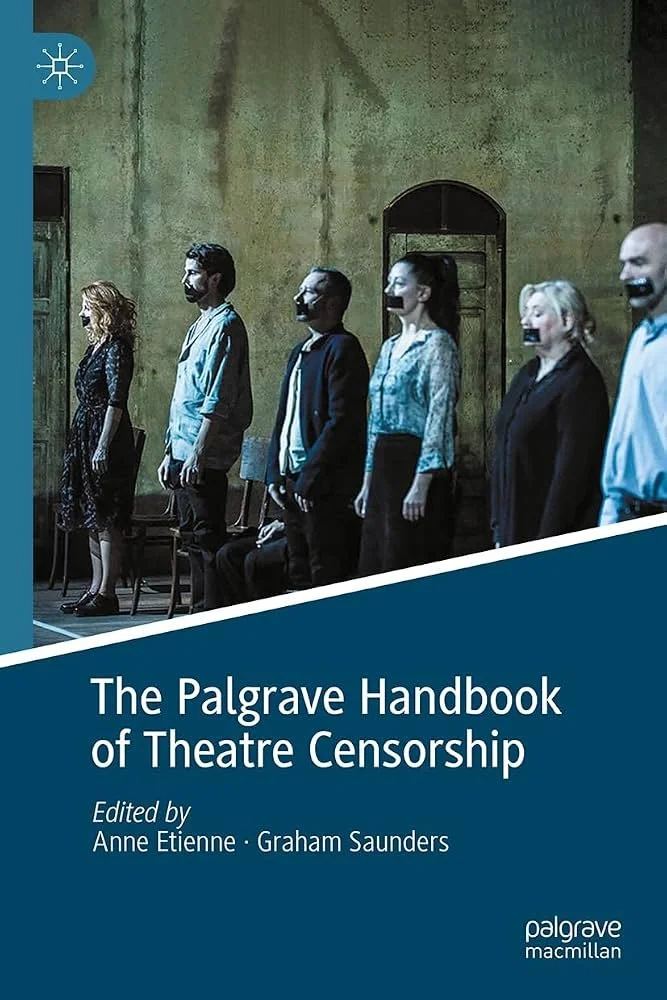
“Moving Censorship: Memory and Reception in Allan McClelland’s Bloomsday, 1962.”
In The Palgrave Handbook of Theatre Censorship, edited by Anne Etienne and Graham Saunders, 553-69. Palgrave Macmillan, 2024.
In this book chapter, I reconstruct the Dublin premiere of Bloomsday, Allan McClelland’s adaptation of James Joyce’s novel Ulysses, only four short years after the Archbishop’s protest led to the Festival’s cancellation. While such a homecoming for a “banned play” may suggest tremendous change or progress in Irish culture, the reality is more complicated. This chapter argues that multiple memories of censorship haunted the 1962 production and shaped its potential meanings. Tracking the movement of censorship memories across time and space through mnemonic “forms” and bodies, the chapter offers a transnational methodology for theorizing censorship’s effects. By reconstructing moments from the performance and interpreting them through the meta-narrative of “change” that these memories of censorship attached to the production, the chapter holds that these transnational censorship memories occlude the play’s political ambivalence and instead allowed it to project progress. Through memory, the chapter’s case study posits, censorship can be understood as a mobile phenomenon that continues its “productive” capacity to help fashion identities, histories, and narratives beyond the time/place of the initial act of censorship.
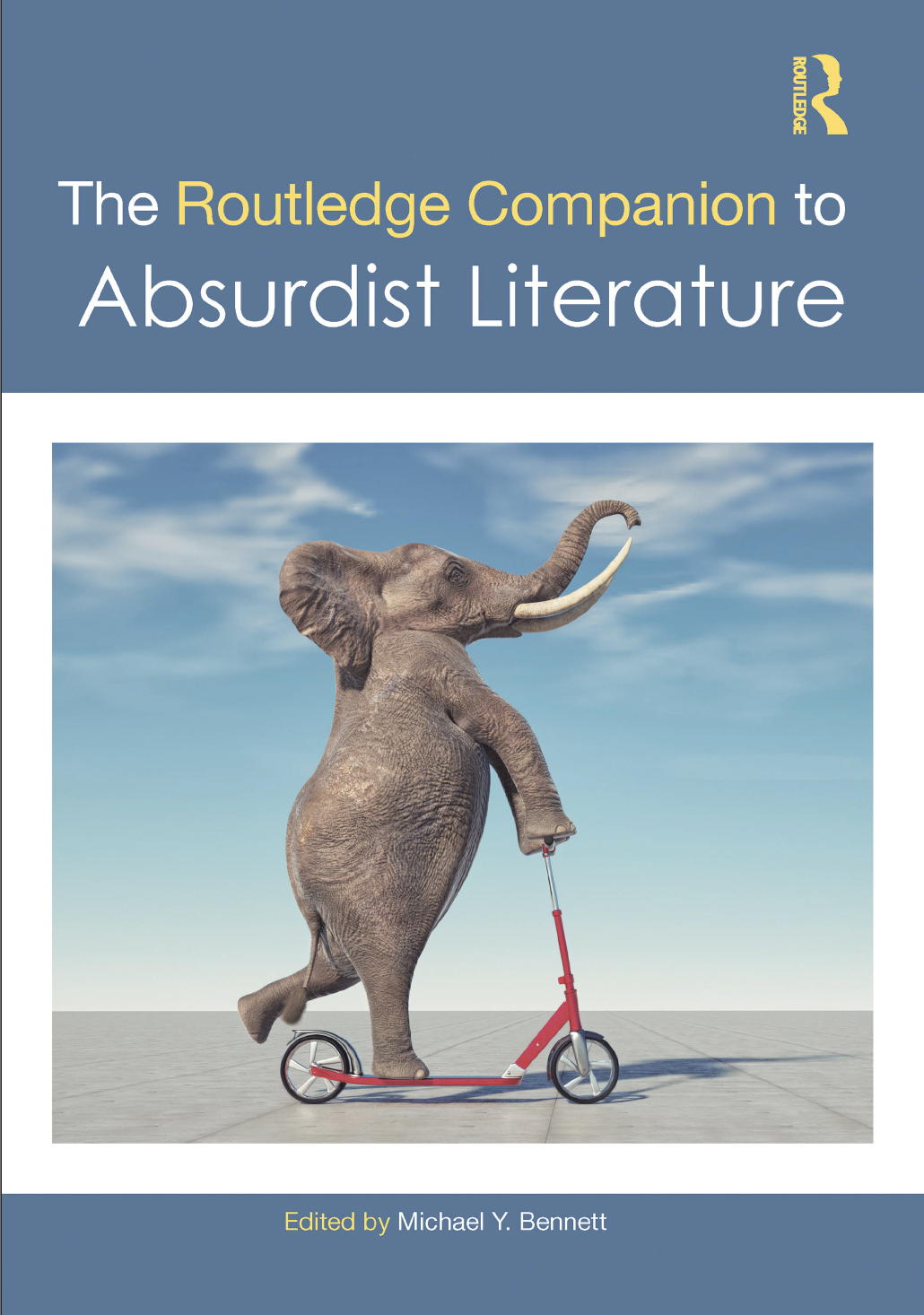
“Decolonization and the Theatre of the Absurd.”
In The Routledge Companion to Absurdist Literature, edited by Michael Y. Bennett, 472-83. Routledge, 2024.
Co-authored with Dr. Hannah Simpson (University of Edinburgh).
This chapter takes an explicitly decolonial approach to Martin Esslin’s The Theatre of the Absurd (1961/1969) and its totalizing, imperialist perspectives. Our contention is that an uncritical reliance on Esslin’s overly universalized, depoliticizing framework particularly obscures what are sometimes explicit representations of colonially inflected violence in the drama Esslin categorizes as “absurd.” Esslin insistently transmutes specific local contexts into generalized comments on ‘the human condition.’ Although scholars are already widening the field of absurd theatre beyond Esslin’s white European focus, decolonizing the field cannot work only by adding new plays and writers into the canon: we also need to probe the colonial-inflected thinking imbedded in Esslin’s articulation of “the absurd,” how scholars deploy that theory, and which thus risks perpetuating imperialist interpretations. Here, we emphasize how the plays that Esslin named the ‘Theatre of the Absurd’ repeatedly dialogue with then-ongoing anti-imperial struggles – engagement which has too often been overlooked because of the shadow cast by Esslin’s depoliticising, universal vision of ‘absurdity’. If we are to continue using Esslin’s ‘absurd’ as a critical lens, we need to push back against the politics this lens reifies: its excessively abstracted vision of ‘humanity’ that ignores the (anti-)colonial detail in many of the foundational ‘absurd’ works of Albert Camus, Samuel Beckett, Arthur Adamov, Eugène Ionesco, and Jean Genet.
“Beckett’s Queer Time of Défaillance: Ritual and Resistance in Happy Days.”
In Beckett Beyond the Normal, edited by Seán Kennedy, 103-16. Edinburgh University Press, 2020.
This chapter draws on Samuel Beckett’s Happy Days production notebooks from his time preparing to direct his own play to argue against critical assessments of Winnie as an exemplar of British pluck — a woman who “goes down fighting.” Rather, the domestic rituals she performs serve to distract her from ever-encroaching entropy. Read in queer time, as chrononormative regulators, Winnie’s rituals are recast as coping mechanisms that help to normalize her abnormal situation. Happy Days thus challenges prevailing understandings of the politics of queer time, queer failure, and performance. Happy Days is here read historically as a response to late capitalism’s regulatory regimes from censorship to gender norms. Winnie’s queer experience of time is the audience’s, too, and her failures implicate them in their own attachments to deadening routine. Winnie’s performance of internalized discipline models (and critiques) how commodity culture deadens existence, but also how theatre as spectacle normalizes suffering.

Ongoing/Future Projects
Mid-Century Irish Drama Anthology
One of the projects I’m most excited about is a new anthology of Irish plays from the 1950s, ‘60s, and ‘70s that I’m developing together with University of Galway theatre archivist and historian Dr. Barry Houlihan. The book will include the complete texts of unpublished and out-of-print plays, including plays by majors authors. Together with critical introductions to each script, the book aims to chart a social, cultural, and political history of Ireland during these three decades through the neglected drama of the period.
Revisiting the Pike Theatre’s Rose Tattoo, 1957
In 1957, the small, independent Pike Theatre in Dublin produced Tennessee Williams’ drama The Rose Tattoo. It was the smash hit of the very first Dublin Theatre Festival. Shortly into the run, however, police arrested the show’s producer and Pike Theatre co-owner, Alan Simpson, for obscenity. Simpson’s appeal went to the Irish Supreme Court and the case was ultimately dropped. Although historians have taken great pains to recreate and analyze the circumstances around the trial, the performance of the play itself has been curiously ignored. In this article-length project, I’m working to explicate the social and cultural meanings that this Irish production of an American class might have produced in its Dublin audience, focusing especially on its performances of gender and sex.
The Scatterin’: An Irish Rock Musical
The Pike Theatre’s last major hit before its shuttering was a new musical called The Scatterin’ in 1960. Irish musical theatre is, itself, an area that has been highly under-researched, but The Scatterin’ presents a special case for musical theatre historiography more broadly as an early example of a rock musical. In this article, I’m working to situate The Scatterin’ within a larger, international history of musical theatre.

Above: Actor John Kavanagh in a revival of The Scatterin’ at the Abbey Theatre, 1973.
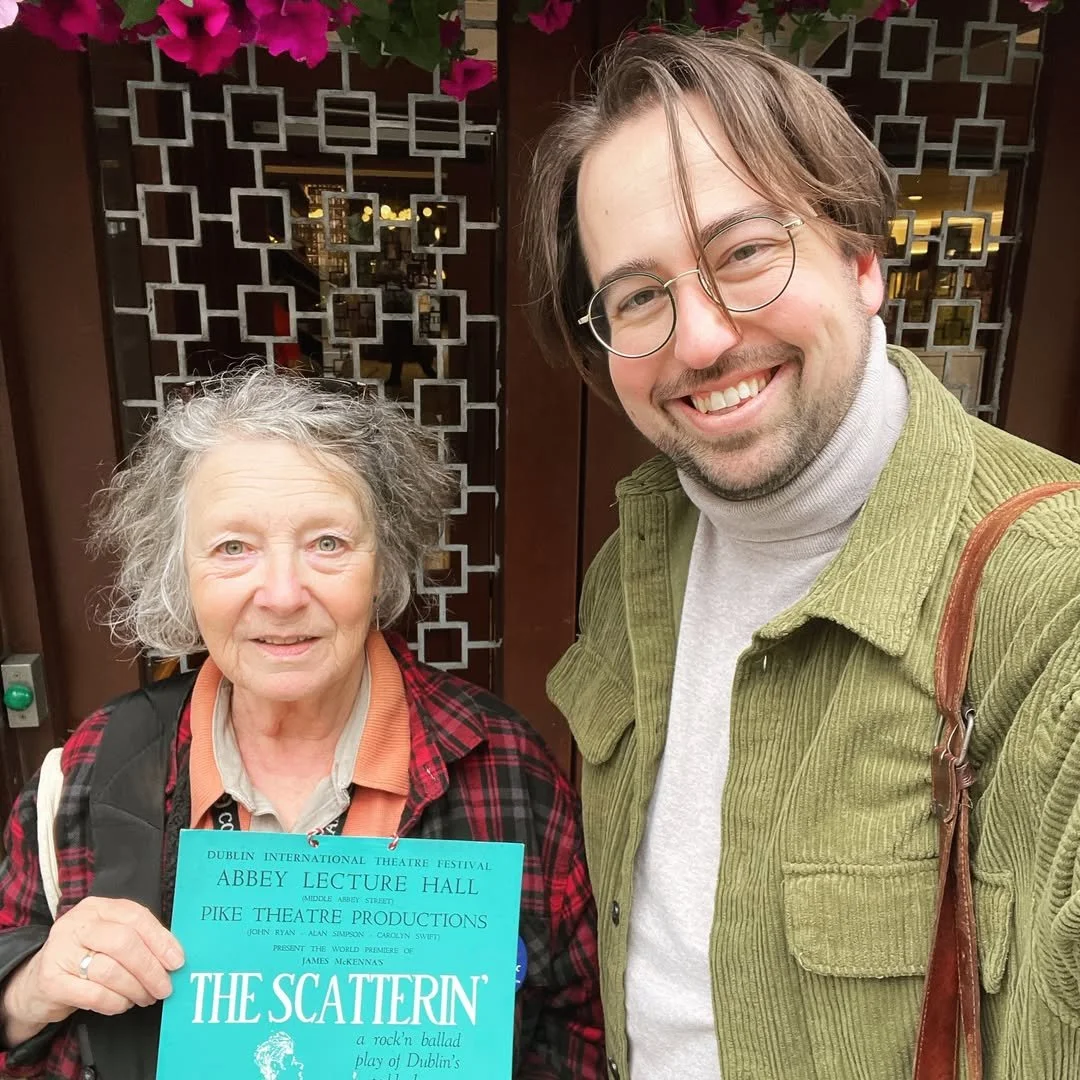
Below: Nic with Maureen Simpson, director and Pike Theatre owner Alan Simpson’s daughter, on a research trip in Dublin. Ms. Simpson, who was also in the original production of The Scatterin’, gifted Nic with an interview as well as a window card from the original production.